


Builds & Racing
Race fever – Baltic Cup 2024 in Paide
If you’ve read our blog before, you’ll know that we divide the RC hobby into two separate branches: hobby modelling and competition modelling. Today we’re talking about the second one – competition modelling – and the emotions and buzz that come with it, just like in any other sport with a competitive element. Of course, the closest comparison can be made with other motorsports or simply technical sports. It’s not always enough to be good yourself; you also need a bit of luck and for your equipment to hold up.
Here I’ll share the buzz and the pain of the Baltic CUP 2024 race, held on 3-4 February, from my own personal point of view. Let me say that I’m far from the fastest RC pilot on the planet, or even in Estonia, but rather an “average joe” who does this sport mainly just “for fun”. I usually finish somewhere in the middle of the final results.
Baltic Cup 2024 race format and classes
Briefly about the race format and the classes raced.
- Number of drivers: 45
- Total models registered across all classes: 65
- Photos: M. Kivisild
The live streams of the race days can be watched back on YouTube:
Qualifying day
Finals day
Venue: Paide, Epiim sports hall.
Track surface: a fairly hard rubber surface on a wooden sports hall floor, relatively slippery. Carpeted jumps.
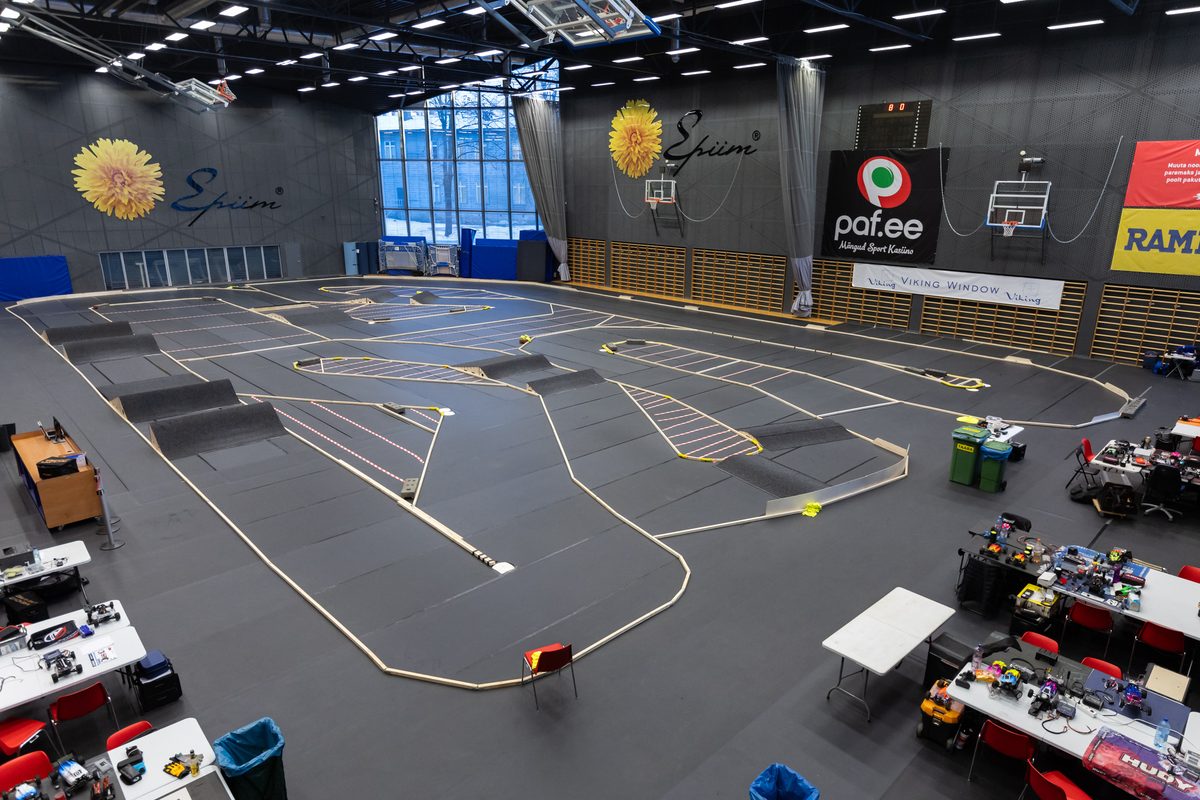
The main race took place over two days, preceded by an optional practice evening on Friday:
- Friday: free practice from 18:00 to 20:15 to get to know the track and set up the car.
- Saturday: practice in groups (2 rounds), aimed at letting drivers learn the track and make the necessary setup changes to their cars, as well as getting an initial comparison of times for forming the qualifying groups. This was followed by 5 rounds of qualifying. The day started at 9 am and the last round finished at around 6:30 pm.
- Sunday: one practice round followed by three rounds of finals.
Three different classes were raced at this event:
- 2WD (rear-wheel drive) 1:10 scale buggy – Stock (13.5T motor) (15 drivers)
- 2WD (rear-wheel drive) 1:10 scale buggy – Mod(ified) (open electronics) (23 drivers)
- 4WD 1:10 scale buggy – Mod(ified) (open electronics) (23 drivers)
In each class, drivers are divided into qualifying groups based on practice runs, and into final groups based on qualifying results. At this event, groups of 8 drivers were formed. Groups are labelled alphabetically, with A being the fastest, followed by group B, C and so on.
- 2WD Stock: 2 groups (A and B)
- 2WD Mod: 3 groups (A, B and C)
- 4WD Mod: 3 groups (A, B and C)
In each round, each group runs one 5-minute timed heat, with the aim of completing as many laps as possible as quickly as possible. In total, 8 heats per round, with each round lasting about 1 hour.
Preparation and cars
On to the race. Preparations started at the beginning of the week, on Monday, when I painted a new body for the 4WD car. I also glued new tyres onto the rims for both the 2WD and 4WD cars. Since it was a multi-day event, I aimed to take part in two classes, so my time would be more fully occupied than racing in just one. I took part in 2WD Stock and 4WD Mod.
My 2WD car was the TLR 22 5.0 AC, originally designed for carpet tracks. Let me say that grip on carpet tracks is very good, and driving a car set up for carpet on a slippery track is extremely difficult, because the centre of gravity is shifted relatively far forward and rear grip is therefore poor. Since this was already the third race in Paide and the track surface had been the same every year, the slippery track was no surprise, and I knew the cars would need significant setup changes to make them better and faster to drive. I tweaked this model a little after each round to find more rear grip. In the photo, the white-blue-yellow car with the black wing, number 66, in the foreground.

My 4WD car was the Team Associated RC10 B74.2, which is also actually designed for high-grip carpet tracks, but four-wheel drive is still easier to keep under control on a slippery surface. I also made a bunch of targeted changes to this car to improve grip and lap times. In the photo, car number 66 in the foreground.

Friday – free practice
There wasn’t much driving time at the Friday practice evening, as there were many people wanting to drive but not everyone fits on the track at once. I did 2 test runs with the 2WD car to get a feel for the track grip and make initial setup changes. Without going into detail, it seemed reasonably drivable given the conditions. On the 4WD, I had previously replaced the so-called slipper clutch at the main gear with a differential, and it already felt so good that I didn’t change anything else in the setup. By then it was already around half past eight in the evening and everyone was politely sent out of the hall, to be back the next morning and start the real race.
Saturday – practice and qualifying
On Saturday morning the doors opened at 9. Before that, I stopped by the Selver next door and picked up some refreshing drinks and snacks to get through the day.
Overnight I’d had some ideas about what else I could improve and try on the cars to cope better with the slippery track. I reworked the rear axle on both models to have more toe-in and also added so-called anti-squat. I tried different shock positions.
By the way, if you’ve never been to a race, let me tell you that the arena is divided into two parts, and both are equally important. The race takes place both on the track and in the so-called pit area, i.e. at the workbench. Everyone is happily together in the pit area and usually shares useful tips for a better setup, even with competitors. Since a picture says more than any number of words, here’s a photo of the pits (that’s me in the black cap looking at something over my shoulder):

LSaturday’s practice laps went more or less well, the cars felt good and I went into qualifying fairly confident. With the 2WD buggy I ended up in group B, i.e. the slower one, and with the 4WD buggy also in group B, i.e. the middle one.
2WD qualifying
2WD qualifying results (the best three out of five count):
- Qualifier 1 – 1st place (10 laps / time 5:22.202, fastest lap 30.706 s, average lap time 32.22 s)
- Qualifier 2 – 1st place (10 laps / time 5:07.387, fastest lap 29.779 s, average lap time 30.739 s)
- Qualifier 3 – 2nd place (9 laps / time 5:06.276, fastest lap 30.634 s, average 34.031 s) (something happened, one lap fewer!)
- Qualifier 4 – 2nd place (10 laps / time 5:27.416, fastest lap 31.478 s, average lap time 32.742 s)
- Qualifier 5 – 2nd place (10 laps / time 5:23.550, fastest lap 31.320 s, average lap time 32.355 s)
So the 2WD qualifying went pretty well in terms of positions. At some point (probably during round 2), there had been a small incident on the track at the end of the long fast straight, where a shock full of silicone oil leaked onto the track. Like any oil, silicone oil is slippery, and slipperiness in a 180-degree corner that follows hard braking is definitely not an ideal situation. Based on an analysis of the laps and times, it can be concluded that this slipperiness visibly affected the following runs. Unfortunately, I could also feel it – with each following round it was clearly noticeable to me that the track was getting more slippery. The situation was especially bad for the rear-wheel-drive buggy. Off-power turning was good, but even with the power turned right down on the stock-motor buggy, the throttle had to be handled with extreme care to keep the car’s nose pointing forward on the track. By the end of qualifying, I managed to drive myself to 6th on the grid in the A final, i.e. I made it into the faster final group. I could already be quite happy with that, as 2WD Stock was meant more as a filler class.
4WD qualifying
Let’s also take a look at the 4WD qualifying runs. Also 5 rounds, with the best 3 counting.
- Qualifier 1 – 3rd place (11 laps / time 5:14.701, fastest lap 26.779 s, average lap time 28.609 s)
- Qualifier 2 – 3rd place (11 laps / time 5:10.959, fastest lap 26.900 s, average lap time 28.269 s)
- Qualifier 3 – 4th place (11 laps / time 5:21.872, fastest lap 26.936 s, average lap time 29.261 s) (did the oil on the track play a role here too?)
- Qualifier 4 – 5th place (11 laps / time 5:13.740, fastest lap 27.389 s, average lap time 28.522 s)
- Qualifier 5 – 8th place (10 laps / time 5:01.958, fastest lap 26.956 s, average lap time 30.196 s)
With the 4WD, you can see that the first four qualifiers progressed at a fairly even pace, but the position gets slightly worse from qualifier 4 onwards. I have to admit that the competitors found more speed and moved ahead. In the last qualifier, the run simply fell apart from lap 8 onwards. The first 7 laps were all nicely completed in the 27–28 second range, and from the eighth lap there were a series of driving mistakes in the lap times – laps of 33 s, 34 s and 37 s respectively. Out of curiosity, I checked the recording to see what exactly happened, and as I expected, mistakes kept creeping in. The last run of the day – I guess fatigue from the long day had set in. Overall, though, the qualifying result was quite satisfactory. I ended up right in the middle of the B final group, in 4th starting position.
To end the day, here’s a photo that clearly shows how close racing can be

Sunday – Finals
The day starts again at 9 am at the table, tinkering with the cars, because the new setup ideas that came up overnight need to be screwed onto the cars before the runs. The shocks on both cars are made softer, with 300 cst silicone oil replacing the previous oil, and the 4WD front shocks get softer springs. On the 2WD buggy I slightly reduce the anti-squat, just to experiment, and fit a wing with a higher wickerbill, in the hope that it might press the rear end down harder.
I go into the practice run with the cars already set up with the changes. The 2WD is still terribly slippery as soon as you press the throttle a little too hard. Hope fades. I decide to just drive quietly at my own pace, try to avoid mistakes and see what happens.
For the 4WD practice, I screw on last year’s worn tyres, hoping that a larger contact patch with the track will give better grip. In addition to the softer oil, the shocks are laid down as far as possible, i.e. in the outermost holes of the shock tower when viewed from the car’s centreline. The car feels OK.
2WD Stock buggy finals
- Final 1 – 8th place (9 laps / time 5:00.252, fastest lap 31.252 s, average lap time 34.275 s)
- Final 2 – 6th place (10 laps / time 5:12.004, fastest lap 30.234 s, average lap time 31.415 s)
- Final 3 – 8th place (10 laps / time 5:15.860, fastest lap 29.938 s, average lap time 32.545 s)
The first final just doesn’t go well – right at the start I get caught in the pack, and during the run there’s a bigger driving mistake on three more laps, costing about 22 seconds in total. At the start of the second final I again get caught in the pack and go off the track, finishing the first lap in last place. By the end of the second lap I’ve climbed two places to sixth and roll nicely to the finish in the same position. Overall, a run without major mistakes. Four laps out of ten are a couple of seconds slower than they could be, but since there are other cars on the track, sometimes you need to let a faster one through or wait behind someone. Feeling better already, I go into the last final fairly hopeful that the last run might be a good one. The start of the third final is good; on the second lap I get caught in a small cluster (see the photo above the finals!), where I lose about 4–5 seconds compared to the other laps. I get out of the situation, and the next three laps pass with very consistent lap times in fourth place. On the sixth lap a couple of mistakes creep in, and on top of that a fellow competitor rams me in a corner, the car does a pirouette and hits another competitor, and a marshal helps the car back onto the track. In total, the mishaps on that lap cost 15 seconds, which simply can’t be made up any more. By the start of lap 7 I’m in last place, where I stay despite a very nice consistent drive all the way to the finish line.
All in all, I achieve a respectable 8th place out of 15 participants. Looking back, a result a couple of places higher would have been perfectly realistic, but that’s motorsport – you need a little luck too. All good!
Pilots in position before the start. The blogger is fourth from the left:

4WD buggy finals
- Final 1 – 7th place (10 laps / time 5:04.432, fastest lap 27.952 s, average lap time 30.419 s)
- Final 2 – 4th place (11 laps / time 5:14.235, fastest lap 26.7976 s, average lap time 28.917 s)
- Final 3 – 6th place (11 laps / time 5:13.335, fastest lap 26.83 s, average lap time 29.078 s)
The feel for the car and track was much better than with the rear-wheel drive. Going into the first final, I made a silly mistake and set the car’s ride height quite low. Combined with the soft shocks, this had an extremely bad effect on the car’s behaviour when landing from jumps. The chassis slammed into the ground, followed by a bounce up and essentially a loss of control. The steering also became very sensitive around the centre position. The run lacked stability, and in the second half of the final the lap times got longer and longer.
For the second final, I raised the ride height considerably and the car’s behaviour improved significantly. I spent most of the run in fifth place, moving up to fourth in the last laps – admittedly thanks to the competitor in 2nd place retiring.
In the last final, I decided to drive more carefully and avoid mistakes, and do a nice consistent run. It almost worked out. I got cleanly through the pack in the first corners of the opening lap and ran in 2nd position for 7 laps. But then bad luck struck and something happened to the car. While driving, I couldn’t tell exactly what was wrong with the car, but the front end seemed lower than normal and turning right was very badly affected, meaning I simply couldn’t take right-hand corners fast. Lap times of 27–28 seconds became lap times of 30+ seconds, and I dropped first to fourth and then to sixth place. Despite this, the racing remained extremely close right to the end – I lost 9 seconds to the driver who finished 2nd in this run. Driving the last 4 laps with the damaged car, I lost about 2.5 seconds per lap, i.e. about 10 seconds in total.
After the run, when inspecting the damage, it turned out that the lower right shock had come loose from its mount on the suspension arm, so I was practically driving the last laps on three wheels.
In the end, 14th place overall in the 4WD buggy class. Without the mishap in the last final, it might have been possible to finish a couple of places higher, but that’s how it went this time.
In the photo below, photographic proof – the shock has left its post:

Summary
All in all, it was an eventful weekend. The track was slippery, and driving the rear-wheel drive was an extreme challenge most of the time. The 4WD was fun, and the company was friendly as always. Thanks to the people of Paide for organising, and perhaps we’ll meet there again next year.

Finally, a group photo of most of the competitors and the models they drove.
