


Beginners
How fast do RC cars go?
When RC cars come up, sooner or later someone always asks how fast an RC car goes. How fast RC cars go is a question with no single good answer. Even one and the same model can drive at very different speeds, depending on many factors. Before we dive into the factors that affect speed, let’s just say that RC car speeds range roughly from 1 to 300+ km/h.
300+ km/h sounds like a lot? It really is a lot, and only RC cars built specifically for maximum top speed can reach it. At the time of writing, the RC car speed record is around 220 miles per hour (UK), or about 350 km/h. Some enthusiasts have set themselves the goal of reaching 250 miles per hour, or 400 km/h. Reaching that kind of speed is difficult even with a full-size car, let alone a model car. At such speeds, the main problem is the car’s wheels and tyres, which just won’t stay in one piece.
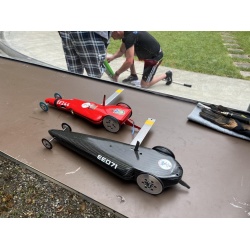
Speeds of 300+ are also reached by tethered speed models that run on a special circular track. These cars are not radio-controlled, but are attached by a cable to a post in the middle of the circle. Building speed models is a thing in Estonia too, and there is a track for it in the yard of Nõmme Youth House (Nõmme Noortemaja). Estonians hold several world records and have won many prizes at championships in this sport around the world. A couple of these models can be seen in the photo with this blog post (A. Aria).
Now let’s come back to reality. How fast do RC cars go when they come out of the box with factory settings? You can get a rough average based on the model’s scale and type. You can also look at whether it is powered by a combustion engine, a brushed electric motor or a brushless electric motor. Models with brushless electric motors have the greatest potential.
How fast do RC cars go with factory settings?
Let’s start from the slower end:
Rock crawlers, 1/18 scale, 1/10 scale, 1/8 scale, 1/5 and 1/6 scale
These models are available in scales from 1/24 to 1/6. The 1/24 scale, the smallest ones, have a speed of around 2–5 km/h. These models are designed to tackle various obstacles and climb rocks, meaning slow driving. The goal is not speed, but the car’s ability to get across terrain. Speeds don’t get much higher in larger scales either. Most of these cars have a single forward gear, and the top speed may be around 10 km/h. Some models have two gears, one slow and one fast. The fast gear on such a model can give a speed of around 20 km/h. However, this speed is only suitable for longer stretches of smoother terrain.
1/18 scale models (on-road and off-road). Models in this scale usually have brushed motors, and their top speed may be around 25 km/h. There are also models with brushless motors, which can also take a more powerful battery with higher voltage. In that case, speeds of 50 km/h or even more can be reached.
There are many different 1/10 scale models, and here speeds can already approach 100 km/h. However, a lot depends on the specific model. So it would be fair to say that the top speed of factory-set models ranges from 35 to 100 km/h. The slower models have brushed motors and NiMH batteries. The faster ones have brushless motors and up to 4S LiPo batteries (four-cell lithium polymer batteries). On average, the top speed of a 1/10 scale car is somewhere between 50 and 70 km/h.
For 1/8 scale, around 70 km/h can be considered a reasonable standard. That’s roughly where the speed ends up. This scale can also loosely include slightly larger models, often labelled 1/7 scale. These are usually just built on a longer chassis, but otherwise assembled from 1/8 scale parts. These models can be faster, as they are made specifically with maximum speed in mind. 100 km/h is a speed that already requires somewhat special tyres, so they don’t fly off the rims due to centrifugal force. So 1/8 scale models reach speeds of 70–100 km/h.
Finally, we can talk about 1/5 and 1/6 scale models. These are cars around one metre long, and they can weigh 15 kg or even more. They are powered by petrol or electric motors. With 1/5 scale models, speeds actually drop compared to smaller ones. The top speeds of petrol-powered models are roughly 60–70 km/h. Electric models can be faster, reaching around 80 km/h. As the model’s weight and speed increase, safety needs to be taken even more seriously. Never drive where there is a risk of hitting people, or where there is a risk to other people’s property if the car gets out of control. It’s not uncommon for the driver to run into themselves either. A model weighing 10+ kg travelling at 70 km/h hurts a lot when it meets someone’s legs, and this situation will very likely end in the plaster room of an A&E department, or even in the operating theatre.
Can an RC car be made faster, and how?
Yes, it certainly can. It can also be made slower. Here it is important to know what the model’s top speed depends on.
A model’s speed basically depends on three components: the gearing, the battery voltage (V) and the motor’s revolutions per volt (kV). All of these can be changed within a certain range, but not infinitely. In addition, these factors are linked, and changing one affects the others in one way or another.
Gearing, voltage and motor RPM
Gearing – this includes the main gearing (the ratio between the motor and the main gear), the ratio between the differential gears, and the model’s wheels are also part of the gearing that affects the final speed. Each model has a fairly narrow ideal main gear ratio range, which can be adjusted by swapping the motor gear (pinion) or the main gear (spur) for one with a few teeth more or less. If you put a larger gear on the motor shaft, the model’s top speed increases. Using a spur with fewer teeth has the same effect. In turn, a smaller pinion or a larger spur makes the car slower, but gives better acceleration and torque. Both too long and too short gearing are bad for the model’s electronics. Gearing that is too long puts too much load on the motor and speed controller, they overheat, and in the worst case they can even burn out. If the gearing is too long (set up for maximum top speed), the car may not be able to pull away from a standstill because the motor doesn’t have enough power.
The wheels also affect the gearing, as well as the model’s top speed and acceleration. Larger wheels give a higher top speed but reduce acceleration. Wheels that are too large put a strain on the electronics and cause them to overheat, to the point where, for example, the electronic components in the speed controller burn out.
Voltage and motor RPM – the motor speed depends directly on the supply voltage. Motor speed is often expressed as kV, which shows how many revolutions per minute the motor makes per 1 V of voltage. For example, if a model has a 3000 kV motor and a 2S (7.4 V) LiPo battery, the motor’s maximum speed is 3000 × 7.4 = 22,200 rpm. If the same motor is used with a 4S (14.8 V) LiPo battery, the theoretical motor speed is twice as high, or 44,400 rpm. Unfortunately, you can’t keep using higher-voltage batteries to increase motor speed endlessly, because every motor has a maximum voltage it can handle without flying apart. This is partly down to physics and centrifugal force, which tries at all costs to throw the magnets off the rotor, and also to the ball bearings the rotor spins on. The winding, or stator, certainly has its own limit too. So every motor has an operating voltage range set by the manufacturer that must not be exceeded.
The rule is that if you build a model for maximum top speed, you sacrifice acceleration and your run time drops significantly, because the electronic components heat up faster and need to be allowed to cool down often to avoid damage.
Well done! Now you know how fast RC cars go and what their speed depends on.
