


Beginners
What is an RC car made of?
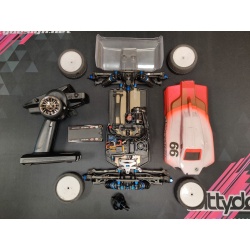
What is an RC car made of? An RC car combines a mechanical component, which is the car’s chassis, and an electronic component, which contains devices that convert the energy stored in the energy source into kinetic energy and heat, and also allow the model to be controlled remotely via radio waves. The energy converter can also be a combustion engine, but in this article we focus on the build of electrically powered models, as they make up the vast majority of models on shop shelves today.
What is an RC car chassis made of?
Broadly speaking, an RC model is quite similar to a real car. On the chassis side, the backbone of the car is usually a chassis plate or a similar frame, to which all the other vital components are attached: the suspension, drivetrain parts, steering system, motor, electronic components and finally a thin body.
Suspension and axles
Just like real cars, models have axles with wheels at the ends. Models can have both independent suspension and solid axles. Solid axles are typical of crawler-type models, which replicate real off-road vehicles, while independent suspension is common on faster models and gives the model better handling at higher speeds. An independent suspension axle consists of suspension arms and shock absorbers with coil springs. The shocks are mostly oil-filled and are attached at one end to the lower suspension arms and at the other end to the shock tower.
Drive, differentials and slipper
Models can be rear-wheel drive or four-wheel drive. A few models are also front-wheel drive. A driven axle always has a differential, which is often filled with suitable oil. Among smaller and cheaper models, you may also find models whose differentials are so-called dry or simply filled with non-flowing grease. Most cars have gear differentials, but some racing models also use ball differentials. A four-wheel-drive car can have a total of 3 differentials, but the third diff can also be replaced by a so-called slipper, or slipper clutch. On 1/10 scale models it is very typical that no differential is used at the main gear, but a slipper instead. The working principle of a slipper clutch is that it reacts to a sudden application of power by slipping, thereby protecting the drivetrain and improving the model’s handling by helping the car’s front wheels stay on the ground. This happens, for example, when starting from a standstill on a high-grip surface. Once the car is already moving, the slipper clutch is practically locked and forms a rigid connection in the drivetrain, distributing drive equally between the front and rear axles.
Drivetrain
Drive is usually transferred from the main gear to the wheels by driveshafts, or cardan shafts, and less often by a belt drive. The main gearing itself is simply 2 gears of different sizes, called the pinion, or driving gear (located on the motor shaft), and the spur, or driven gear (located on the centre diff or slipper). As a rule, the main gearing reduces the motor RPM passed on to the drivetrain and increases the torque. A similar reduction also takes place in the axle gearing, which also has gears through which the RPM reaching the wheels is reduced even further, but the torque is increased accordingly.
The mechanical side is simple and understandable for most people who have dealt with cars. The electronics side of the models is a little more complicated, as the differences from real cars are somewhat bigger here.
Electronics: motor, ESC and radio system
The main electronic components are the power system, which in electric models consists of an electric motor and an electronic speed controller. The latter is often abbreviated as ESC. Written out in full, it is the English term “Electronic Speed Control”. The ESC controls the motor’s operation, essentially supplying it with electric current. The ESC is the brain of the RC car and gets its power directly from the drive battery. In addition to the motor, the ESC also powers the radio system, whose onboard components include the receiver and the servos. The other important part of the radio system is the transmitter, or remote control, which is held by the model’s driver and is used to send control signals to the model. An electric model typically needs one servo, which is used to move the steering system, i.e. to turn the steering. A model with a combustion engine needs two servos, one of which also turns the steering, while the other handles the throttle and brake function. Some models may have more servos, for example for gear shifting, locking the differentials, operating a handbrake or whatever mechanical movement may be needed.
A radio signal travels through the transmitter and receiver, giving the ESC and servos commands to apply throttle or brake, turn the steering right or left, or how the servos connected to the other controlled channels should behave. On hobby models, at least the steering and throttle/brake functions are always proportional, meaning the car turns exactly as much and as quickly as the driver turns the wheel on the transmitter or presses the throttle/brake trigger. The other channels may have stepped control – for example, with two or three positions.
Battery
An RC car needs electrical energy to bring its electronics to life. Electricity is also needed for a model with a combustion engine, as it powers electronic components such as the radio system, and the motor & ESC. In an electric model, the need for electrical energy is greater, and higher-capacity and higher-voltage batteries are used – drive batteries. A car with a combustion engine uses a smaller battery, also called a receiver battery. Since the receiver battery only powers the receiver and, through it, the servos, a battery with much lower capacity is sufficient.
Body
On top of everything, RC cars are fitted with a body, which is generally moulded from polycarbonate that is colourless and transparent in its original form. Many factory-made bodies come with printed graphics. Aftermarket bodies are sold unpainted, which lets the model’s owner unleash their own creativity and artistic talent and paint their model’s body as nicely and beautifully as their skills allow. But that’s a topic for one of our next blog posts.
