


Beginners
Which RC car is best as a first model?
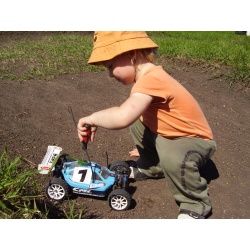
Which RC car is best as a first model? We hear this question quite often, and rightly so. For someone just starting to explore the world of RC models, the huge selection can be quite overwhelming. As with many other things, there is a lot of terminology in the model world that isn’t easy to understand at first. On top of that, there are different scales, electric and nitro engines, batteries and radios, transmitters and receivers. Where should you start untangling all of this? The simplest way might be a strategic approach using the process of elimination. To do that, we could divide all the RC cars in the world into increasingly detailed groups, starting with the most general.
First division: toys vs hobby models
Of course, broadly speaking, all models are toys, but based on certain characteristics, RC cars can be divided quite clearly into two large groups. By toys, we mean cars that are generally sold in toy shops at a relatively low price. One common feature is their simple construction, another is the lack of spare parts. A toy is disposable: if something goes wrong with it, either mechanically or electronically, it usually ends up in the bin.
A hobby model is one that the manufacturer supports with spare parts. Such an RC car is designed in much greater detail and has incomparably better driving characteristics. As a rule, the electronics of a hobby model are modular, and individual components can be replaced one at a time as needed. The same goes for spare parts. If you manage to break a part, the whole model doesn’t go in the bin; you can get your little car running again by replacing the part in question.
ClayPitRC deals exclusively in hobby models, and so should you. Leave the toys in the shop, the fun of driving them won’t last long. Once you’ve made this choice, you’ve already taken the first step in the right direction.
Now let’s move on to the second step
Hobby models are further divided into racing models (often with the word KIT in the name) and ready-to-drive models (often with RTR in the name). For their first model, 99.5% of people choose an RTR (ready to run) model, meaning one that is ready to drive straight away, because it is assembled at the factory and includes all the necessary components. Usually you need to buy a battery and charger separately for an RTR model, but not always; some models include them as well. We’ll talk more about ready-to-drive models right after a brief overview of racing models.
Racing models are designed specifically for the race track and are usually bought by someone who knows exactly what they need, meaning it’s certainly not their first model, but more likely one of many. That said, buying a racing model as your first model shouldn’t be ruled out if you have a fairly firm wish to take it to the race track. In that case, it’s a perfectly right choice. When buying a racing model, keep in mind that they are sold as kits, meaning the parts needed to build the chassis. They do not include electronics, often not wheels either, and sometimes not even a body. All of this has to be bought separately, which makes a drivable model considerably more expensive than a comparable RTR set. What makes a racing model more expensive is the engineering that goes into it. Behind these RC cars are entire teams, endless hours of testing, developing and trialling different components. These models are made from lighter and higher-quality materials (carbon fibre, titanium, high-quality steels and aluminium alloys, composite plastics of different stiffness) and offer a wide range of setup options. If you want to be competitive on the race track, a racing model is the only right choice.
Coming back to RTR models, which will most likely be your first model too, we are now getting much closer to answering the question we started with. Although the selection of RTR models is very large, from our point of view here at ClayPitRC, no single one is better or worse as a first model. The selection criteria are often, of course, the price of the model and the age of the future pilot. For a younger modeller, a smaller-scale model (1/18 scale) works well, with a price of around a couple of hundred euros. For an older beginner RC car enthusiast, a better choice might be at least a 1/10 scale model. By the way, 1/10 scale is the scale with the widest selection. But how do you actually make the choice? That’s a question everyone has to answer from their own heart. The right model is most likely exactly the one you like the most at that moment and that puts a smile on your face. The rule that more is better applies here, of course. There is a risk that your first model won’t be your last. If you start enjoying it, you’ll soon find yourself standing between the shelves of a model shop again, picking out your next model.
Summary
So ClayPitRC’s advice is to follow your heart (and perhaps a little bit your wallet too). Take the one you like the most; there is no right or wrong choice here. There is no RC car that is more or less suitable for a beginner. What matters is an interest in technology and a readiness to grab a screwdriver when a part of your model needs some maintenance. The classics have also said that the right model is the one that puts the biggest smile on your face. You certainly can’t argue with that; that’s exactly how it is!
