



This time, we are diving into a crucial topic group that every beginner RC car owner needs to master: model maintenance and its related workflows. This article explores the answers to the most common questions we face every single day:
- Is it necessary to maintain an RC model, how do I do it, and how often?
- Am I allowed to repair and disassemble the model myself?
- Can I drive my RC car in wet conditions, mud, or snow?
At first glance, you might wonder how water and RC cars tie together, but we promise there is a very direct and important connection. Read on to find out!
Your Model is Not a Perpetual Motion Machine
Whether you are currently planning to buy your very first model or have just recently become a proud owner, you must realize that an RC car is not a maintenance-free machine that only provides driving joy. A hobby-grade RC car is a relatively complex mechatronic device that requires care between battery packs.
Because hobby models are built to be driven outdoors, they come into constant contact with everything nature throws at them—dust, mud, water, gravel, and loose dirt. How often you need to service your model depends entirely on your driving environment and whether conditions are wet or dry. Models generally prefer dry environments, as dust doesn't stick to the chassis in massive clumps and has a harder time penetrating vital components like ball bearings, differentials, and oil-filled shocks.
Some manufacturers (such as ARRMA) outline specific maintenance intervals in their manuals, usually measured by battery cycles. It is highly recommended to follow these guidelines, but not every brand includes such a detailed breakdown. In those cases, the owner must evaluate the physical condition of the chassis and decide whether it's time for a partial or complete teardown.
"Am I Allowed to Disassemble and Repair the Model Myself?"
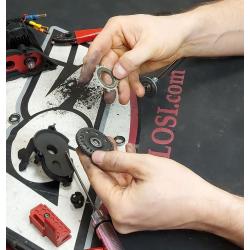
You might already guess the answer to this question: Yes, absolutely! In fact, disassembling your model is a mandatory and fully encouraged part of the hobby experience. Without stripping the model down to its core modules, it is physically impossible to perform proper maintenance, as you simply cannot access the components that need cleaning, shimming, or re-greasing.
We are frequently asked if washing the entire model under a shower or blast-cleaning it with a pressure washer is considered "sufficient maintenance." Blasting a fully assembled model with a pressure washer is something we strongly advise against, and here is why:
- Pressure washing pushes dirt into bearings: Even though the car looks sparkling clean after a high-pressure wash, it actually isn't. A pressure washer excels at forcing fine sand and moisture deep into places they should never go—such as rubber-sealed ball bearings, hinge pin blocks, and tight gear meshes. The end result is a clean-looking car that suddenly refuses to roll or binds completely.
- "Waterproof" does not mean rustproof: While many RC cars feature "waterproof electronics" on the box, you must apply common sense. An electric brushless motor will technically run completely submerged under water, but it is not watertight. Problems arise later when the internal iron components—such as the stator, shaft, and rotor bearings—begin to rust. Water and corrosion have a catastrophic, destructive effect on ball bearings.
If you want to wash your suspension and chassis parts with water, you must first completely disassemble the model, removing all electronics and ball bearings beforehand. Wash the composite plastic components separately where every single crevice is accessible.
How to Diagnose If Your Model Needs Service
If you aren't dealing with routine silicone oil changes inside your shocks or diffs and want to evaluate the general state of your drivetrain, the test is incredibly simple: Ensure the drivetrain rolls completely free of friction and does so without any unusual noises (squeaks, grinding, or clicking).
Since electric motors inherently create significant magnetic resistance when rolling, it is best to remove the motor pinion or back the motor mount away to disengage the gear mesh. Roll the chassis across a flat table with your hand. It should glide smoothly.
If you hear a gritty grinding or high-pitched squeak, your first task is to check all wheel bearings. Ball bearings are consumable wear items. Fine dust, water, and mud will inevitably bypass the seals over time, causing the internal grease to wash out and the steel balls to seize. During a routine overhaul, if you find a bearing that feels gritty, rough, or is completely locked up, it must be replaced immediately. Most high-quality bearings can be cleaned, re-lubricated with bearing oil, and resealed if caught early before internal pitting occurs.
Pre- and Post-Run Visual Inspection
A basic inspection should be carried out before and after every single battery pack. This is mostly a visual sanity check:
- Ensure all chassis screws are tight (especially metal-to-metal screws secured with threadlock).
- Clear out any foreign debris (like small rocks wedged near the outdrives or steering rack).
- Check for excessive slop or play in the wheels. A wobbling wheel usually means either the wheel nut has backed off, or the wheel bearings are blown and about to disintegrate entirely.
You should also frequently inspect your spur and pinion gear mesh, especially if your platform uses an open gear cover, a slipper clutch, and a composite plastic spur gear. Clean the internal debris out of the power module regularly. At the same time, check your motor bearings—particularly the front bearing right behind the pinion. If you detect lateral or axial play in the motor shaft, replace the motor bearing immediately. If a motor bearing disintegrates at high RPM, the rotor will slam into the stator, instantly destroying the internal electronics and forcing you to purchase a completely new motor.
The Reality of Running in Mud, Water, and Snow
Driving in wet, muddy, or snowy conditions can be incredibly fun, but you must accept that every hour of wet bashing demands hours of meticulous maintenance at your workbench afterward.
Moisture causes rapid, severe corrosion on all steel hardware—screws, turnbuckles, cvd driveshafts, and bearings will rust overnight if left damp. Furthermore, water usually carries ultra-fine abrasive silt or sand. This slurry acts exactly like liquid sandpaper, grinding down your suspension arms, outdrives, and drive pins at an accelerated rate.
We have seen models brought into our shop that were driven in salt water at the beach and left unserviced. In multiple instances, the corrosion was so catastrophic that rebuilding the veermik and replacing the seized electronics would cost significantly more than buying a brand-new RTR kit.
In Conclusion
Enjoy your model, push it to its limits, and go find some mud if that brings a smile to your face! Just remember to match that driving joy with proper, routine maintenance at your pit table. Keep your veoahel clean, your bearings oiled, and your gear mesh set, and your hobby gear will reward you with exceptional performance run after run.
Here is a video on the ClayPitRC YouTube channel, where you can watch the maintenance of an Arrma Kraton 4x4 4S main drivetrain from start to finish: